Disclosure: This review is an editorial assessment based on the official Steam store page, public Steam user-review summary, feature list, screenshots, pricing, and store description checked on August 19, 2026.
What Big Walk is
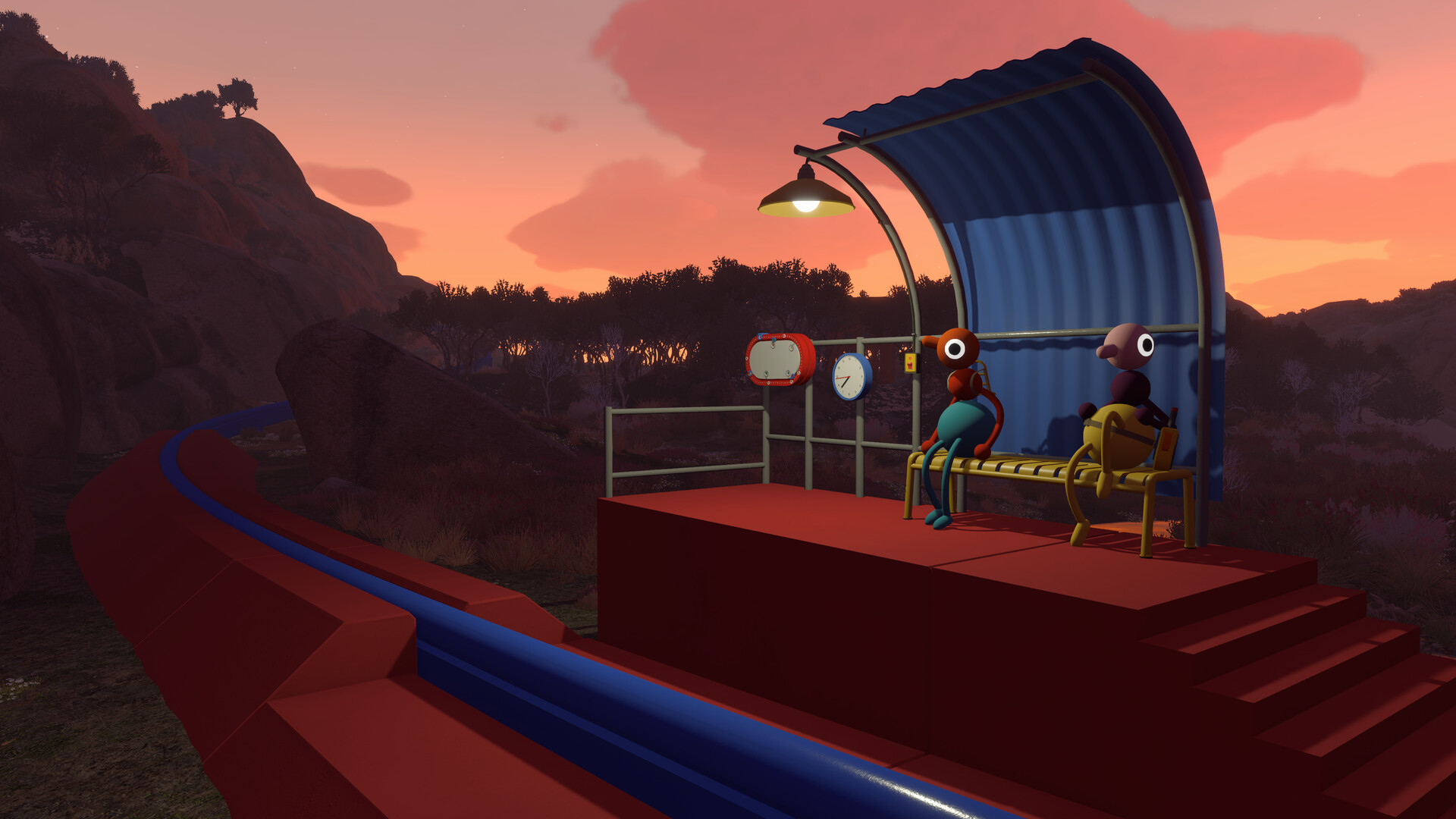
Big Walk is a cooperative online adventure from House House and Panic about moving through a wide-open world with friends, staying in contact, and figuring out what to do when contact breaks down. Steam describes it as a multiplayer adventure about teamwork and talking, and that is the useful frame: this is not a loot chase or a combat-first survival game. It is a game about the social texture of traveling together.
The official feature list makes communication the main mechanical surface. Proximity voice fades over distance, echoes down corridors, muffles through walls, and crackles through walkie-talkies. Arms, gestures, laser pointers, binoculars, megaphones, flares, whiteboards, and other tools turn coordination into something physical and fallible. Big Walk is at its best when a simple plan becomes a story because someone misunderstood a signal or wandered too far away.
Why the co-op works
The most interesting thing about Big Walk is how little it needs to push. Many co-op games treat downtime as a problem to solve, but Big Walk treats it as the point. Walking, talking, getting separated, making jokes, and repairing confusion are all part of the loop. That gives it a different rhythm from puzzle-box co-op games where every room has a single clean answer.
The flexible 2-12 player range matters. With two or three players, Big Walk can become a focused co-op trip where voice distance, tools, and navigation create intimate problem solving. With a larger group, it becomes messier and funnier, and the world has enough room for side conversations, bad directions, and accidental leadership changes. The same mechanics support both modes because the game is built around presence rather than strict role assignment.
Structure, pacing, and group dependence
Big Walk is hand-crafted and meant to be played start-to-finish with a group of friends, which gives the wandering a destination without turning every minute into objective pressure. That balance is important. The game needs enough structure to keep a group moving, but enough looseness that the best moments can come from a stolen tool, a missed callout, or a plan that dissolves into laughter.
The tradeoff is that Big Walk depends on the people you bring. A quiet lobby can make the pace feel undercooked, and players who want deep progression systems may read the openness as thin. This is a deliberate design risk. House House is betting that the way friends talk, hesitate, split up, and reassemble can carry a whole adventure. With the right group, that bet pays off.
Steam reception
Steam reception is already strong. When checked on August 19, 2026, the Steam user-review endpoint listed All Reviews as Very Positive, with 19,024 positive reviews out of 20,196 total user reviews. English reviews were also Very Positive, with 14,623 positive reviews out of 15,417. That public response lines up with the game's strengths: it is easy to explain, easy to share, and memorable when the group chemistry clicks.
Who should play it
Big Walk is easiest to recommend to players who already like co-op games as social spaces. If you enjoy wandering through an authored world, laughing at bad coordination, and using voice chat as part of the design rather than just a utility, this is a strong fit. It also has clear appeal for streamers and friend groups because the action reads well even when the immediate objective is vague.
It is less ideal for solo-first players, progression grinders, or anyone who wants a dense challenge curve. Big Walk is more confident as a shared journey than as a mechanical test. That confidence is why it stands out, but it also defines the audience.
Pros and cons
Pros
- Proximity voice chat, walkie-talkies, gestures, and toys make communication the central play system.
- The 2-12 player range lets the same world support quiet teamwork or messy group exploration.
- Hand-crafted spaces reward wandering, joking around, and shared discovery rather than checklist clearing.
- Cross-platform multiplayer and full controller support make it easy to gather a mixed group.
- The tone is confident: Big Walk knows that hanging out can be the main event, not filler between objectives.
Cons
- Players who need constant mechanical pressure or loot progression may find the pace too loose.
- A weaker group dynamic can flatten the experience, because much of the fun comes from conversation and improvisation.
- The joke-first toolset can occasionally make navigation and coordination feel deliberately messy.
Final verdict
Big Walk scores 8.7/10 because it turns friendship friction into a design strength. The walking is simple, but the communication around the walking is rich: voices fade, tools get misused, gestures replace words, and the world gives groups enough space to make their own trouble. It will not satisfy players who measure co-op games by loot, combat density, or constant optimization. For everyone else, it is a sharply observed, generous, and unusually social adventure.
FAQ
Is Big Walk worth playing?
Yes, especially with friends who enjoy relaxed online co-op, voice chat, exploration, and emergent group comedy. GamerReviewHub scores Big Walk 8.7/10.
How many players does Big Walk support?
The Steam page says Big Walk can be played with as few as 2 players or as many as 12, with online co-op and cross-platform multiplayer listed among its features.
Is Big Walk a puzzle game?
It includes challenges, puzzles, and discoveries, but it is better understood as a cooperative adventure about communication and shared navigation than a pure puzzle game.